
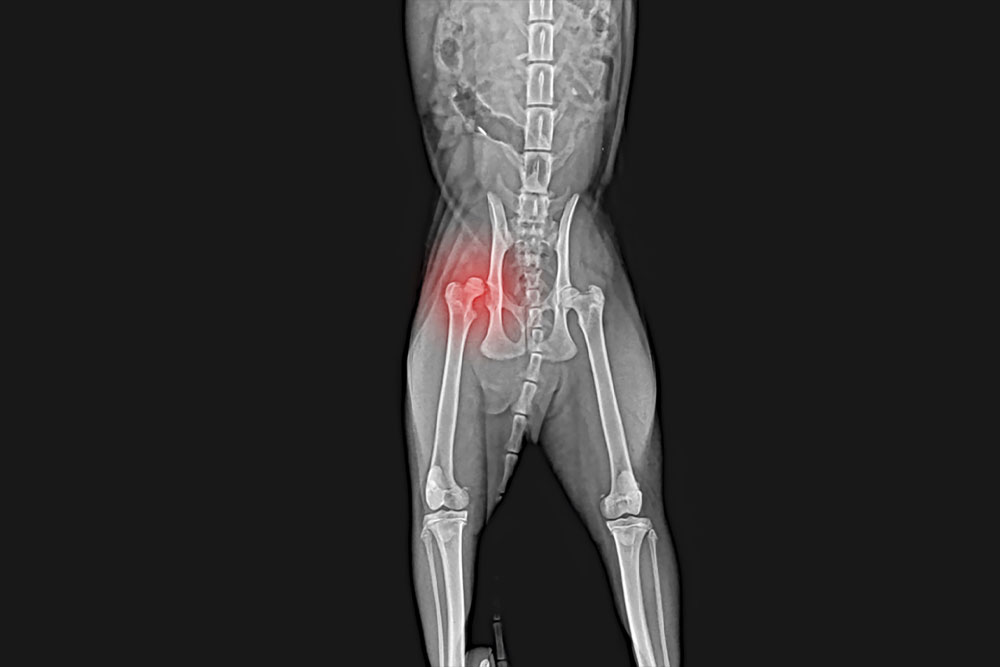
The condition inside the joint and your pet’s lifestyle, not a standard playbook, decides which hip procedure makes sense. Hip dysplasia, a hip that keeps slipping out of its socket, Legg-Calve-Perthes disease, and end-stage arthritis each damage the joint differently, so the same menu of options gets weighed differently for each. That menu is wider than most families expect. It runs from juvenile procedures that reshape how a young dog’s hips develop, to repairs that stabilize a dislocated hip, to a femoral head ostectomy that removes the diseased ball, to a total hip replacement that rebuilds the joint with implants, to a medical plan built on medication, weight control, and joint support. Plenty of hips never need the operating room at all, which is why the workup comes first.
A painful hip makes many pets brace against being handled, and an orthopedic exam means moving the joint that hurts. At Star of Texas Veterinary Hospital in Austin, Fear Free care means that exam can happen on the floor, in your lap, or outside, wherever your dog or cat feels safest. X-rays then tell us which condition we’re dealing with. When surgery turns out to be the answer, a board-certified surgeon comes to our hospital for advanced procedures, so most pets have their hip repaired in the building they already know rather than starting over somewhere unfamiliar. Get in touch and we’ll start with the diagnosis, not the surgery menu.
Start With the Joint, Not the Procedure
- Hip surgery isn’t one operation but a range, from juvenile procedures in puppies to joint replacement in adults, and the diagnosis decides which one belongs on the table.
- Surgery is rarely the first move, since most pets try medication, weight control, and rehabilitation first.
- Body weight and activity matter enormously, because smaller dogs and most cats do beautifully with an FHO while larger, athletic dogs often benefit more from a full replacement.
- Puppies caught early can sometimes avoid arthritis entirely through time-sensitive procedures that reshape how the hips grow.
What Actually Goes Wrong Inside a Hip Joint?
A healthy hip is a ball riding smoothly in a deep, cupped socket, and hip disease is almost always that fit breaking down. When the ball and socket no longer match, grind, or lose their blood supply, cartilage wears through and the joint turns painful. Four conditions account for most of these breakdowns, each damaging the joint differently.
| Condition | What goes wrong | Who it hits most |
| Hip dysplasia | Ball and socket grow mismatched, joint stays loose | Large-breed dogs, and quietly, some cats |
| Hip luxation | Ball forced out of the socket | Any pet after trauma |
| Legg-Perthes | Blood supply to the ball fails, bone crumbles | Small-breed young dogs and cats |
| Severe arthritis | Cartilage worn through, chronic pain | Older dogs and cats |
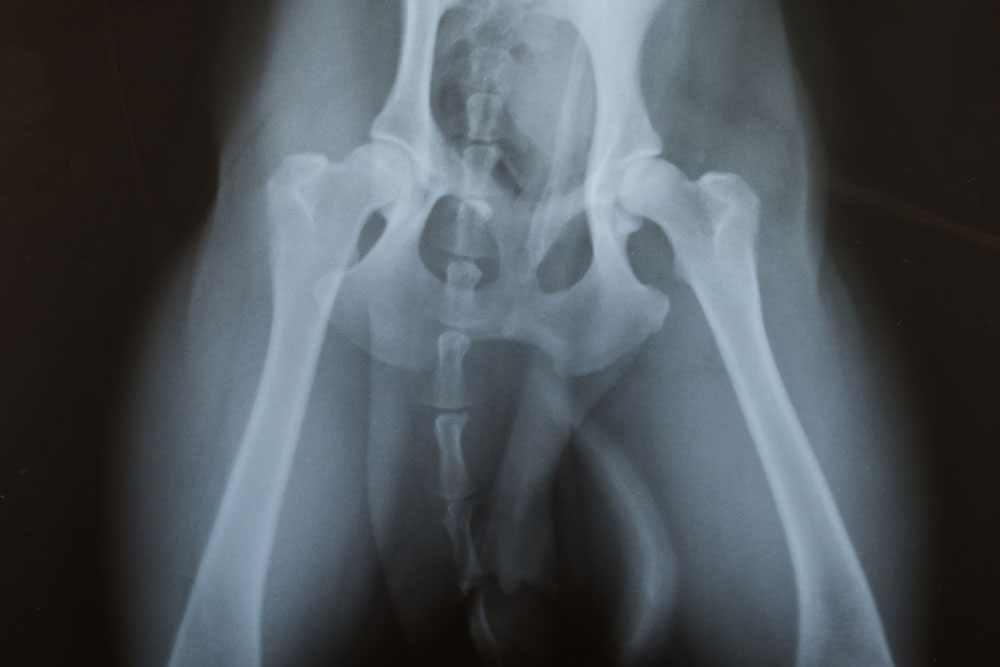
How does hip dysplasia affect dogs and cats?
Hip dysplasia is developmental, starting while the joint is still forming in a growing puppy or kitten. Canine hip dysplasia develops when the ball and socket grow at slightly different rates, leaving a loose joint that grinds itself into arthritis. Large and giant breeds carry the most risk, including Labradors, Golden Retrievers, German Shepherds, Rottweilers, and Saint Bernards, though any dog can be affected. It also tends to be a two-sided problem, so a dog limping on one leg often has changes brewing in the other hip as well.
Feline hip dysplasia is the one we tend to miss, because cats rarely limp the way dogs do and instead quietly stop jumping or climbing until the joint is already badly arthritic. Maine Coons and other large breeds see it more often.
What causes a hip to slip out of joint?
Hip luxation happens when the femoral head is forced out of its socket, usually after a fall or car accident. Pets with hip dysplasia are more likely to experience a luxation, since their hip joint doesn’t fit together properly. It’s the one hip problem that arrives all at once rather than developing over years, and it needs attention quickly, because a hip left out of joint damages the surfaces on both sides.
What is Legg-Perthes disease?
Legg-Perthes disease, also called avascular necrosis, cuts off blood flow to the femoral head until the bone begins to crumble, and it shows up most often in cats, toy and terrier breeds, and other small dogs, typically between five months and a year old. Because the damaged bone can’t heal back into a working ball, removing it is almost always the answer, and these young, light patients recover remarkably well afterward.
When does arthritis become bad enough to operate on?
Advanced osteoarthritis in dogs and cats becomes a reason to consider surgery once medication and rehab can no longer keep a pet comfortable, and cats often signal it by hiding or skipping jumps rather than limping. Arthritis is the end result of most chronic hip problems, and for years it can be managed without an operation. The line gets crossed when a pet hurts every day despite good care.
Which Hip Surgery Fits Which Problem?
There isn’t one hip operation, there are several, and each exists because a different thing went wrong. Two only work in young dogs whose skeletons are still growing. Two rebuild or replace a joint that has already failed. One puts a dislocated hip back where it belongs.
| Procedure | What it does | Best suited to |
| Juvenile pubic symphysiodesis | Fuses part of the growing pelvis so the sockets rotate into a tighter fit | At-risk puppies under about five months, before arthritis starts |
| Pelvic osteotomy | Cuts and rotates the pelvic bones to swing the socket over the ball | Young dogs with loose hips but no arthritis yet |
| Femoral head ostectomy | Removes the damaged ball so soft tissue forms a flexible false joint | Cats, small and medium dogs, Legg-Perthes, and salvage cases |
| Total hip replacement | Rebuilds both ball and socket with implants | Larger, athletic dogs where near-normal function is the goal |
| Hip luxation repair | Returns the ball to the socket and stabilizes it there | Pets whose hip dislocated from an injury or severe dysplasia |
Weighing hip dysplasia treatment options is less about picking a favorite procedure and more about matching one to your pet’s age, size, diagnosis, and daily life.
Can Surgery on a Puppy Prevent Arthritis Later?
Two time-sensitive procedures can reshape a young dog’s hips before arthritis ever sets in, giving a loose hip a tighter, more stable fit as the dog grows and potentially sparing the bigger operations later.
Juvenile pubic symphysiodesis is a quick, minimally invasive procedure done before about five months of age that fuses part of the growing pelvis so the hip sockets rotate into a tighter fit as the puppy matures. For slightly older puppies who already have laxity but no arthritis, a pelvic osteotomy cuts and rotates the pelvic bones to swing the socket over the femoral head and hold it there.
The catch with both is timing, and it’s tighter than most families realize. For an at-risk breed, laxity testing that can be done as early as sixteen weeks is what makes an early procedure possible at all, so raise your concerns at your first or second puppy visit. By the time a limp shows up, the window has usually closed.
What Is an FHO, and Which Pets Does It Suit?
A femoral head ostectomy removes the diseased ball and lets the body build a cushion of scar tissue in its place, creating a flexible false joint. With no implant and no matched socket to fit, it’s simpler and more affordable, and it works best in smaller, well-muscled patients. The trade-off is that a false joint isn’t a perfectly engineered ball-and-socket, so larger dogs may show a slight hitch in their stride.
Which pets are the best candidates for an FHO?
FHO shines in smaller, lighter patients, making it the go-to for cats of nearly every size, small and medium dogs, and young dogs with Legg-Perthes. It’s also the fallback when a total hip replacement isn’t feasible, whether from cost, other health issues, or joint changes that rule out an implant. Strong muscle around the hip is the biggest predictor of a good result, which is why a lean, active cat or a springy terrier does so well, while a heavy, sedentary dog needs a more careful conversation about expectations.
What does FHO recovery look like?
FHO recovery centers on movement, not rest, because the false joint only forms well when the pet keeps using the leg. Gentle, guided activity starts within days, which in an Austin summer means getting those first short walks in early, before the afternoon heat sets in. Physical rehabilitation isn’t optional here. Most dogs and cats use the leg comfortably within four to six weeks, with continued strengthening for a few months. Cats need a different approach, since you can’t convince most cats to take leashed walks. Gentle play and movement are what helps the false joint mature.
What Is a Total Hip Replacement, and Which Pets Does It Suit?
Total hip replacement swaps both the femoral head and the socket for prosthetic implants that recreate a nearly normal hip, restoring full, pain-free function in the large majority of carefully chosen patients. Unlike an FHO, it rebuilds true joint mechanics rather than relying on scar tissue.
It’s the most technically demanding option on this list, performed by a board-certified surgeon with the implant system the procedure requires. Complications are uncommon but real, including the implant dislocating or an infection settling around it, which is why patient selection and a careful recovery matter as much as the operation.
Which pets are the best candidates for a total hip replacement?
Total hip replacement is usually the better fit for larger, heavier dogs, athletic and working animals, and any pet where restoring completely normal function is the priority. Implant sizing has come a long way, so cats and small dogs are candidates too. The decision rests on more than size, so a working dog who runs all day and a couch-loving companion of the same weight may land on different sides of the line.
What is recovery like after a hip replacement?
Hip replacement recovery is strict, with tightly controlled activity for the full eight to twelve week healing period while bone grows into or cement sets around the implant. No running, jumping, or off-leash freedom during that window, for dogs and cats alike. Cats need special planning around their vertical world, because one launch onto a counter can undo the repair in a second, so bookshelves and cat trees get blocked off. Once healed, most patients return to full, unrestricted activity, often more active than they’ve been in years.
How Is a Dislocated Hip Put Back Together?
A dislocated hip is the one hip problem that arrives all at once, usually after a car or a bad fall, and it’s the one where a non-surgical fix has the best shot. Roughly half of pets do well with a closed reduction, where the ball is eased back into the socket under sedation and held with a sling while the joint capsule heals.
When the hip re-dislocates, or the injury tore too much of the supporting tissue, surgery stabilizes it. A toggle rod technique threads a strong suture through the socket and the top of the femur to act as a replacement ligament while scar tissue builds, and repairing the joint capsule directly is another option. For cats and small dogs, or for a hip that has been out too long to salvage, an FHO is often the simpler and more reliable answer.
When Is Non-Surgical Management the Right Call?
Many pets with hip disease never need surgery, and conservative management is the right first step for most, especially in early or mild cases where pain is controllable. A good plan works on several fronts at once, and done well it keeps a lot of hips comfortable for years.
The pieces of a solid plan include:
- Pain and inflammation control: Daily anti-inflammatory medication is the backbone for many pets. Monthly injectable options target arthritis pain specifically, one for dogs and a separate one for cats, a real step forward for pets who can’t take daily pills.
- Joint supplements: Products with omega-3s, glucosamine, and chondroitin support cartilage, and joint supplements for orthopedic conditions work best as one steady layer of a broader plan.
- Weight control: Nothing takes daily pressure off a sore hip like weight management, since every extra pound multiplies the load the joint carries with each step.
- Rehabilitation: Veterinary physical rehabilitation uses targeted exercises, underwater treadmills, and hands-on therapy to build the muscle that braces an unstable hip.
- Comfort therapies and home tweaks: Acupuncture can ease arthritis pain alongside medication, and simple changes like ramps, runners on slick floors, and orthopedic bedding make daily life easier on tender joints.
How Does Diet Shape a Growing Pet’s Hip Health?
What a large-breed puppy eats in their first year shapes whether at-risk joints develop well or poorly, making nutrition one of the few hip-disease levers a family fully controls. The goal is steady, moderate growth rather than getting big fast.
Growing too fast on too many calories overloads joints that are still forming, the mechanism behind many developmental orthopedic conditions. Large-breed puppy formulas slow and steady that growth curve, and measured portions matter as much as the food itself.
What Does Hip Care Actually Look Like at Our Hospital?
Our role is to give you a clear, honest picture, and it starts with figuring out what’s wrong before anyone talks about operating. That means a hands-on orthopedic exam and diagnostic imaging to see the joint, followed by a frank conversation about what each path would mean for your pet.
What surprises new clients most is how much of this happens without your pet leaving a building they already know. A board-certified surgeon comes to us for advanced procedures, so hip surgery here means the same reception desk, the same exam rooms, and the same people through recovery, pain management, and rechecks.
The other part is how we get through the exam itself, because manipulating a painful hip is exactly what teaches a dog to dread the clinic. As Austin’s first Fear Free certified practice, we have real tools for that. A Happy Visit or Victory Visit lets an anxious pet build good associations with no handling at all, and for deeper fear, a pre-visit pharmaceutical consult sorts out medication and handling strategy before the appointment that matters. Cats get their own Cat Friendly setup with a cats-only exam room and waiting area, which is worth a great deal when the patient is an arthritic senior who already hates the carrier.
Cost is a real part of this decision too, and Cherry payment plans can help make a bigger procedure reachable when it’s the right call.
Common Questions About Hip Surgery in Dogs and Cats
Will my pet walk normally again after hip surgery?
Most pets return to comfortable, active lives after hip surgery, though the mechanics differ by procedure. A total hip replacement recreates a near-normal joint, so gait usually looks completely normal once healed. An FHO relies on a false joint of scar tissue, so a very observant eye might catch a slight difference in stride, especially in larger dogs, but the pet is out of pain and doing what they love.
Is my cat too small for hip surgery?
Cats are excellent surgical candidates, not too small at all. Their light weight and natural agility make them ideal for an FHO, and many recover so well that the false joint becomes essentially invisible in how they move and jump. The bigger challenge isn’t their size but their recovery, since keeping a cat from leaping onto high perches during healing takes real planning.
If both hips are bad, do they both need surgery?
Not always, and not usually at once. Many dogs with two-sided dysplasia are painful mainly on one side and do well after that hip is addressed, partly because they stop overloading it. When both hips genuinely need surgery, they’re staged weeks to months apart so your pet always has a stronger leg to lean on. We’ll look at the films for both sides and tell you honestly what we expect.
How do I know if it’s time to consider surgery instead of medication?
Surgery generally comes up when good medical management is no longer keeping your pet comfortable. Watch for daily signs that pain is winning: reluctance to rise, trouble with stairs or jumping, loss of muscle over the hips and back legs, more time resting, or a shorter fuse when handled. Cats may simply stop using favorite high spots. If your pet is still struggling despite good care, that’s the moment to talk with us about whether an operation would give them a better quality of life.
Getting Clarity on Your Pet’s Hip Health
A hip decision is almost never an emergency, and it’s not one you have to make in a single visit. The right answer depends on your pet’s diagnosis, size, and activity, and on what fits your family. Our job is to help you get there without pressure. If your dog or cat is slowing down, favoring a back leg, or has been diagnosed with a hip problem, request an appointment and we’ll figure out what that hip actually needs, whether it turns out to be an operation here at Star of Texas Veterinary Hospital or a comfort plan we manage together.